
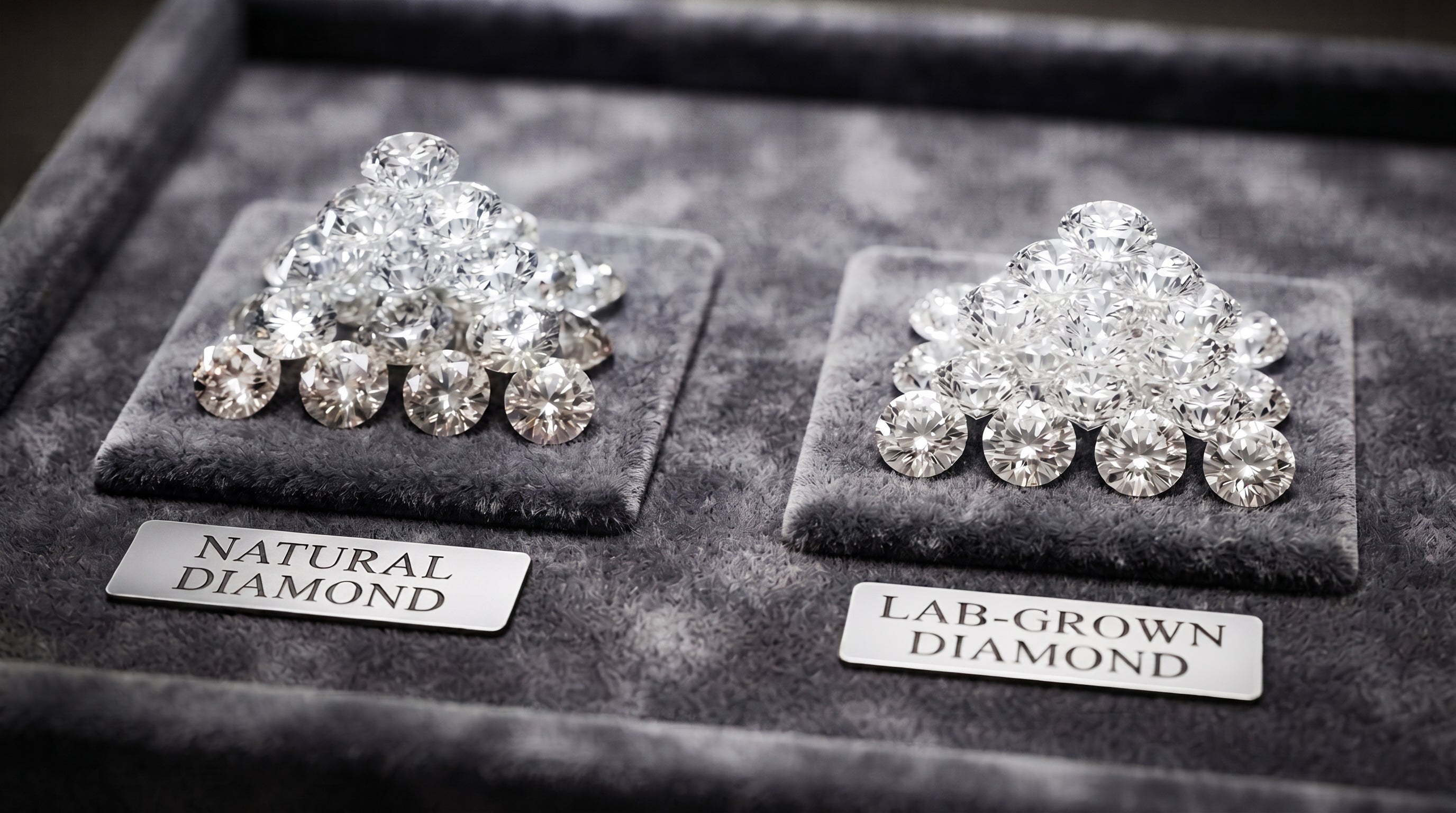
Lab-Grown vs. Natural Diamonds: Understanding the Real Differences Before You Buy
Few topics in the jewelry industry have created as much conversation and confusion as lab-grown diamonds.
For generations, natural diamonds have been admired as rare gemstones formed deep within the earth over billions of years. Today, advances in technology allow diamonds with the same chemical composition and crystal structure to be created in highly controlled laboratory environments.
This has given consumers more choices than ever before—but it has also raised many questions.
Are lab-grown diamonds real diamonds? Why do they cost less? Do natural diamonds still matter? What should buyers consider before making a purchase?
The answer depends on what matters most to you.
Understanding the differences between natural and lab-grown diamonds can help you make a more informed decision.
Are Lab-Grown Diamonds Real Diamonds?
Yes.
A lab-grown diamond is a real diamond.
Both natural and lab-grown diamonds are made of crystallized carbon and share the same basic physical, chemical, and optical properties. They have the same hardness, brilliance, and fire that people associate with diamonds.
The primary difference is origin.
A natural diamond forms deep within the earth over billions of years under intense heat and pressure.
A lab-grown diamond is created using advanced technology that replicates the conditions necessary for diamond formation in a controlled environment.
The result is a diamond—not a diamond imitation like cubic zirconia or moissanite.
The distinction between natural and lab-grown diamonds is not whether one is "real" and the other is not. The difference is how each diamond came into existence.
Why Do Lab-Grown Diamonds Cost Less?
The biggest difference most consumers notice is price.
Lab-grown diamonds are generally less expensive than comparable natural diamonds, largely because of differences in supply.
Natural diamonds are limited by geological availability. They require exploration, mining, sorting, cutting, and distribution before reaching the jewelry market.
Lab-grown diamonds can be produced using modern technology, allowing manufacturers to increase supply as production methods improve.
As more lab-grown diamonds have entered the market, prices have declined significantly in many categories.
This does not mean lab-grown diamonds are lower quality or less beautiful. It reflects the difference between a naturally occurring resource with limited supply and a product that can be created through controlled manufacturing.
Why Do Some People Choose Natural Diamonds?
Many buyers choose natural diamonds because they value their rarity and origin.
A natural diamond represents a remarkable geological process that began billions of years ago. Each stone is the result of conditions that occurred naturally over an immense period of time before eventually becoming a finished gemstone.
For some people, that history is an important part of the diamond's meaning.
Natural diamonds also have an established place in the jewelry market, particularly among buyers who specifically want a naturally formed gemstone.
Some people appreciate the individuality of natural diamonds—the fact that each stone has its own characteristics and story.
For these buyers, the appeal is not simply the appearance of the diamond. It is also the connection to something rare and naturally occurring.
Why Do Some People Choose Lab-Grown Diamonds?
Lab-grown diamonds appeal to many buyers for different reasons.
For some, the ability to purchase a larger diamond or a higher-quality diamond within a certain budget is the primary attraction.
Others appreciate the technology involved in creating diamonds in a controlled environment.
Some buyers prefer to focus primarily on the diamond's physical characteristics—such as size, cut, color, and clarity—rather than its origin.
A lab-grown diamond can be an excellent choice for someone who wants a beautiful diamond and values having more flexibility in their budget.
There is no single reason people choose lab-grown diamonds, just as there is no single reason people choose natural diamonds.
Are Natural and Lab-Grown Diamonds Different in Appearance?
One of the most common questions buyers ask is whether they can see a difference between a natural diamond and a lab-grown diamond.
The short answer is: sometimes, but not simply because one is natural and one is lab-grown.
Both natural and lab-grown diamonds have the same chemical composition, crystal structure, and optical properties. A well-cut diamond of either origin can display exceptional brilliance, fire, and sparkle.
However, diamonds are not identical simply because they share the same specifications.
The individual characteristics of a diamond—including cut quality, proportions, clarity characteristics, fluorescence, and subtle color differences—all influence how it looks when worn.
Some buyers are drawn to the individuality of natural diamonds. Because they formed deep within the earth over billions of years, natural diamonds often have unique characteristics created during their formation. For some people, those natural variations are part of the appeal.
Others appreciate the precision, clarity, and availability of larger sizes that lab-grown diamonds can offer.
In larger diamonds especially, individual characteristics can become more noticeable. A very large diamond with exceptional clarity and color may have a crisp, highly uniform appearance, while another diamond may have subtle warmth, character, or visual nuances that appeal to a different buyer.
Neither appearance is automatically better—it comes down to personal preference.
This is also why seeing diamonds in person remains such an important part of the buying process. A grading report can describe a diamond's characteristics, but it cannot fully capture how a diamond catches the light, how it looks from different angles, or what appeals to your eye.
Understanding Resale Value
One of the most important differences between natural and lab-grown diamonds is how the secondary market views them.
When purchasing any significant piece of jewelry, it is helpful to understand that the original retail price is not necessarily the amount you could receive if you later decide to sell the piece.
This is true for all jewelry, including natural diamonds.
However, lab-grown diamonds are a newer category, and their resale market is still developing. Because lab-grown diamonds can be produced with increasing efficiency and supply has grown substantially, resale prices have generally not followed the same patterns historically associated with natural diamonds.
For many buyers, this is not a concern. They are purchasing a lab-grown diamond because they value its beauty, size, and affordability and intend to enjoy wearing it.
For others, the long-established desirability and secondary market for natural diamonds may be an important consideration.
The key is understanding the difference:
A lab-grown diamond may offer excellent value as a beautiful piece of jewelry, but buyers should not assume that its future resale value will reflect its original retail price.
How Should You Decide Between Natural and Lab-Grown?
The right choice depends on your priorities.
A buyer who values rarity, natural origin, and geological history may prefer a natural diamond.
A buyer who prioritizes size, specifications, or budget flexibility may prefer a lab-grown diamond.
Neither choice is automatically right or wrong.
The important thing is making sure you understand what you are buying and why.
A knowledgeable jeweler should be able to explain both options clearly, answer questions honestly, and help you compare diamonds based on your priorities—not pressure you toward one choice.
Final Thoughts
The conversation around natural and lab-grown diamonds is not really about choosing a winner.
It is about understanding two different ways of owning a diamond.
A natural diamond represents billions of years of geological history, rarity, and a connection to the natural world.
A lab-grown diamond represents modern technology, innovation, and a new way to create one of the world's most admired gemstones.
Both can be beautiful. Both can be meaningful. And both can be the right choice for the right person.
The most important decision is not simply where a diamond came from.
It is choosing a diamond you understand, appreciate, and will enjoy wearing for years to come.
Read more
How to Buy an Engagement Ring with Confidence
Buying an engagement ring doesn't have to be intimidating. Learn how to compare rings thoughtfully, understand what really affects price, recognize lasting value, and choose a jeweler you can trust...
Read more
How Do Jewelers Determine What Jewelry Is Worth?
Ever wonder how jewelers determine what jewelry is worth? Learn the questions experienced jewelers ask when evaluating gold, diamonds, gemstones, craftsmanship, condition, designer pieces, and mark...
Read more